
The Rideshare Insurance Coverage Gap: What Texas Uber and Lyft Drivers Are Missing
Quick Answer: Yes — driving for Uber or Lyft in Texas requires coverage beyond a standard personal auto policy. A dangerous gap exists between the moment you turn on the app and the moment you accept a ride. Neither your personal insurer nor the rideshare company’s policy fully covers that window. A rideshare endorsement or specialty policy closes it.
Why This Matters for Texas Rideshare Drivers
Texas is one of the busiest rideshare markets in the country. Houston, Austin, Dallas, and their surrounding suburbs generate enormous rideshare demand, and drivers in Katy, Fulshear, Sugar Land, and across Fort Bend County are actively running the app. For many, it is supplemental income. For some, it is a primary livelihood.
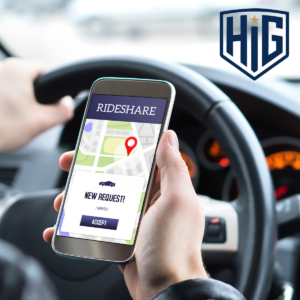 What most of those drivers do not know — until they need to file a claim — is that their personal auto insurance policy has almost certainly excluded them from coverage the moment they opened the Uber or Lyft app. Insurers view driving-for-hire as a commercial activity, and personal auto policies are explicitly written to exclude commercial use in most cases. The rideshare companies provide some coverage, but it has significant limits that leave drivers personally exposed.
An accident without the right coverage does not just mean a denied claim. It can mean personal liability for medical bills, property damage, and legal costs that add up to numbers most people cannot absorb on their own.
The Three Periods of Rideshare Coverage — and Where the Gap Lives
Understanding how rideshare insurance works requires understanding that the coverage situation changes depending on what stage of a trip you are in. The industry has standardized these into three distinct periods:
Period 0: App Is Off
When the Uber or Lyft app is not active, you are driving as a private individual. Your personal auto insurance applies normally, exactly as it would on any other drive. There is no coverage gap here.
Period 1: App Is On, No Ride Accepted
This is where the gap lives. You have turned on the app and are waiting for a match. You are driving around, or parked somewhere waiting for a ping. Your personal auto insurer considers this a commercial use and, in most cases, will deny a claim that occurs during this window. Uber and Lyft provide only limited liability coverage during Period 1 — Uber’s Texas contingent coverage in this period is typically $50,000 per person / $100,000 per accident for bodily injury and $25,000 for property damage. There is no collision or comprehensive coverage from the platform during Period 1. If someone hits you and is uninsured, or if you hit a parked car, that is largely on you.
Period 2: Ride Accepted, En Route to Passenger
Once you accept a ride request, Uber and Lyft’s commercial liability policy activates at much higher limits — typically $1,000,000 in liability coverage. Collision and comprehensive coverage also kicks in, subject to a deductible (typically $2,500 with Uber, $2,500 with Lyft). This period has the best coverage of the three.
Period 3: Passenger in the Vehicle
Coverage during Period 3 is the same as Period 2. The $1,000,000 liability umbrella and platform collision/comprehensive coverage apply through the end of the trip dropoff.
The math is clear: the period with the worst coverage is the one where drivers spend a meaningful portion of their working time — cruising the app, repositioning between rides, and waiting for the next match. Filling that gap is the entire purpose of rideshare-specific insurance.
What Your Personal Auto Policy Actually Says About Rideshare
If you have not read your policy’s exclusions section recently, you should. Standard personal auto insurance policies in Texas typically include language that excludes coverage when the vehicle is being used to carry persons or property for a fee, or while the vehicle is being used in connection with a transportation network company (TNC), which is the formal term for Uber, Lyft, and similar services.
Some insurers have updated their language to specifically reference TNC exclusions by name. Others rely on broader commercial use exclusions. Either way, the result is the same: a claim that occurs while the app is active and no ride is accepted may be denied, and if you did not disclose your rideshare activity to your personal insurer, you may also face a policy cancellation.
This is not a technicality that can be argued around at claim time. It is a fundamental structural limitation of personal auto insurance policies that has been tested in courts and consistently upheld. The solution is not to hope your insurer does not find out — it is to have the right coverage in place before you ever need it.
Your Options for Closing the Rideshare Coverage Gap
Option 1: Rideshare Endorsement on Your Personal Auto Policy
Many major insurers now offer a rideshare endorsement that can be added to an existing personal auto policy. This endorsement explicitly extends your personal policy’s coverage into Period 1, filling the gap that neither your personal insurer nor the platform covers. The cost is typically modest — often $10 to $20 per month added to your existing premium. This is the most straightforward solution for part-time drivers and works well when your primary goal is eliminating the Period 1 exposure.
Not every insurer offers this endorsement in Texas, and the coverage terms vary. An independent agent who works with multiple carriers can identify which options are available to you specifically.
Option 2: Commercial Auto Insurance
Full commercial auto insurance provides the broadest protection and is designed for drivers who treat rideshare as a primary income source or drive very high mileage. It covers all three periods comprehensively and removes the ambiguity of layered coverage between a personal policy and a platform policy. The trade-off is cost — commercial auto insurance premiums are meaningfully higher than personal auto rates.
Option 3: Hybrid Rideshare-Specific Policy
Some specialty insurers offer policies specifically designed for rideshare drivers that function as a bridge between personal and commercial coverage. These are priced between a standard endorsement and a full commercial policy and may be the right fit for full-time or near-full-time drivers who do not need the full scope of a commercial policy.
Rideshare Coverage Comparison: What Each Option Addresses
| Coverage Scenario | Personal Policy Only | With Rideshare Endorsement | Commercial Auto |
|---|---|---|---|
| App off (Period 0) | Covered | Covered | Covered |
| App on, no ride (Period 1) | Not covered | Covered | Covered |
| Ride accepted (Period 2) | Not covered | Platform coverage applies | Covered |
| Passenger in car (Period 3) | Not covered | Platform coverage applies | Covered |
| Deductible on collision | Your deductible | Platform deductible in P2/P3 | Your commercial deductible |
| Policy cancellation risk | High if not disclosed | None | None |
The Mistake That Gets Texas Rideshare Drivers in Trouble
The single most common error is assuming that because Uber or Lyft provides a $1,000,000 liability policy, you are fully covered. That coverage only exists during Periods 2 and 3, and it only addresses liability. During Period 1, the platform’s coverage is limited and provides zero collision or comprehensive protection for your own vehicle.
Here is what that looks like in a real scenario: You open the Lyft app in a Katy parking lot, waiting for your first ride of the evening. A distracted driver rear-ends your vehicle while you are sitting still. Your car sustains $8,000 in damage. You are not at fault. The other driver is uninsured.
Your personal auto policy says the app was on, so the TNC exclusion applies. Lyft’s Period 1 coverage provides no collision or comprehensive protection for your vehicle. You have uninsured motorist coverage on your personal policy, but your insurer may argue that since the TNC exclusion voided your policy for this period, that coverage does not apply either. You are now looking at an $8,000 repair bill with no clear path to reimbursement.
A rideshare endorsement that costs less per month than a tank of gas would have prevented that entire scenario. Working with an agency that understands the complete coverage picture, the way the team at Hayslip Insurance Group approaches auto coverage, makes that kind of gap impossible to miss.
What Rideshare Drivers Should Do Right Now
- Pull out your current auto policy and read the exclusions section. Look for any language referencing transportation network companies, TNC, driving for hire, or commercial use. If you see an exclusion and you have the app on your phone, you have a gap.
- Contact your insurance agent and disclose your rideshare activity. Failing to disclose is not a strategy — it is a fast path to a denied claim and potential policy cancellation. Disclosure is always the correct move.
- Ask specifically about a rideshare endorsement. If your current carrier offers one in Texas, compare the cost against your risk exposure. The math almost always favors the endorsement.
- If your carrier does not offer a rideshare endorsement, shop for one. Not every insurer has caught up with the rideshare market. An independent agent with access to multiple carriers can find one that has.
- Consider your mileage and how much you drive. Part-time drivers who average 10 hours per week are in a very different risk position than full-time drivers running 50+ hours. The right coverage level reflects how much time you spend in each period.
Why Choose Hayslip Insurance Group for Rideshare Coverage
Rideshare insurance is one of those coverage situations where having an independent agent in your corner makes a material difference. Here is why:
- Access to multiple carriers and programs: As an independent agency, Hayslip Insurance Group works with a range of insurance partners across Texas. When one carrier does not offer a rideshare endorsement, or when their terms are unfavorable, there are alternatives to evaluate. A captive agent tied to one carrier cannot make that comparison for you
- Local, personal service: When a claim happens, you need someone who knows your policy and can advocate for you quickly. The Hayslip team serves drivers across Katy, Fulshear, Houston, Sugar Land, and Fort Bend County with the same personal attention that has driven their five-star reviews
- Bundle opportunity: Many rideshare drivers who are renting their home or apartment can combine rideshare-endorsed auto coverage with renters insurance for a bundled discount that often offsets the cost of the endorsement itself
- Honest gap analysis: The first conversation is a coverage review, not a sales pitch. If your current policy is actually adequate, you will hear that. If it is not, you will understand exactly where the gaps are and what the options cost
Rideshare driving should be a way to earn income, not a source of financial risk. Getting the right coverage in place first is the only way to make sure it stays that way. Request a quote that includes a rideshare coverage review and know exactly where you stand before your next shift.
Frequently Asked Questions: Rideshare Insurance in Texas
Will my insurance company cancel my policy if they find out I drive for Uber or Lyft?
Potentially, yes. If you have not disclosed rideshare activity and your insurer discovers it during a claim, they can deny the claim and, in some cases, cancel or non-renew your policy. The correct approach is to proactively disclose to your agent and ask about a rideshare endorsement. Disclosure may result in a modest premium adjustment, but it protects your policy and your claim eligibility. Hiding the activity is never worth the risk.
Does the Uber or Lyft insurance cover my car if I cause an accident during Period 1?
During Period 1 (app on, no ride accepted), Uber and Lyft provide contingent liability coverage at reduced limits — typically $50,000 per person for bodily injury, $100,000 per accident, and $25,000 for property damage. There is no collision or comprehensive coverage from the platform during Period 1. If you cause an accident and your personal policy excludes TNC use, you have limited platform liability coverage and zero vehicle damage coverage. A rideshare endorsement fills both of those gaps.
I only drive for Uber on weekends. Do I still need a rideshare endorsement?
Yes. The coverage gap exists regardless of how often you drive. A single at-fault accident during Period 1 on any given Saturday can result in a denied personal auto claim. The frequency of rideshare driving does not change the structural nature of the coverage gap — it only changes how often you are exposed to it. The cost of a rideshare endorsement is low enough that it is always the right call for any active rideshare driver, regardless of hours.
Can I drive for both Uber and Lyft with one rideshare endorsement?
In most cases, yes. Rideshare endorsements are typically written to cover activity with any TNC, not a specific platform. You should confirm with your agent that the endorsement language covers multiple platforms, but most properly written rideshare endorsements in Texas do. This means you can freely toggle between apps without needing separate coverage for each platform.